
For the hiker looking for a strenuous hike the hills of Hockley Heights Side Trail are an obvious attraction. Less obvious is the history of forest management hidden in its pines and maples. The first clue is a Town of Mono sign denoting the area ahead as “Anderson Tract”.
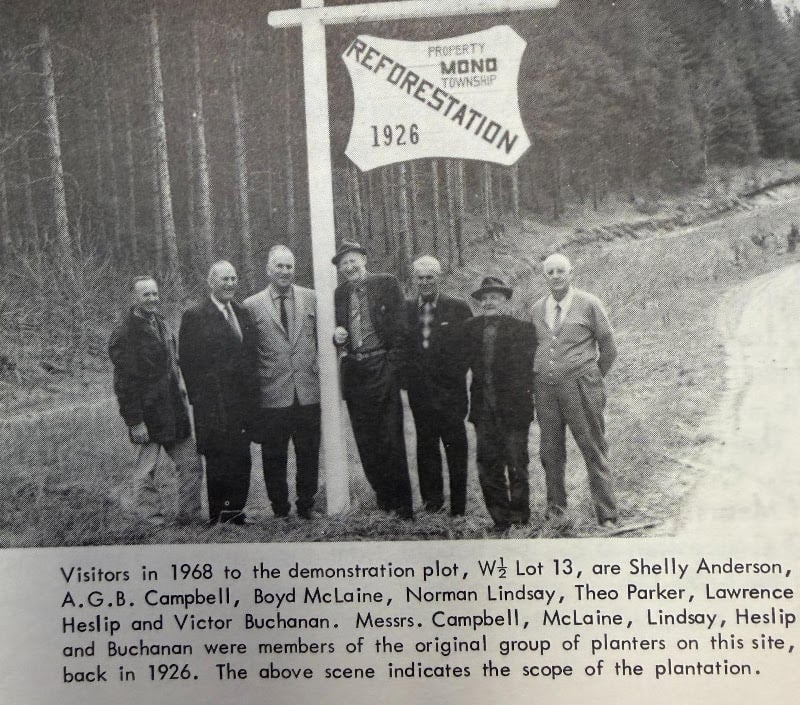
The Anderson Tract is a square 100 acres of land named for Sheldon J.(Shelly) Anderson. Shelly Anderson was a force in Forest Management within the Town of Mono from 1949 to at least 1968. But the story starts well before him.
Before European settlement the area was treed with maple, beech, basswood and elm with cedar, spruce, balsam and tamarack in the lowlands. Settlers started the backbreaking work of clearing the land and by 1910 only about 19% of the land was left forested. Around this time the effect of removing so much tree cover was starting to become apparent. Trees stabilize the soil and prevent erosion. In many areas the soil blew away.
By the early 1900’s government started taking an interest. H.A Dorrance was County of Dufferin’s first Agricultural Representative and was an advocate of reforestation. Some landowners took up the idea and planted pine and spruce over large areas. In 1924 Mr. Dorrance persuaded Mono Township Council to seriously consider reforestation. In 1926 the council paid $250 for 98 acres of land which became known as Tract 1926. Four more purchases followed.
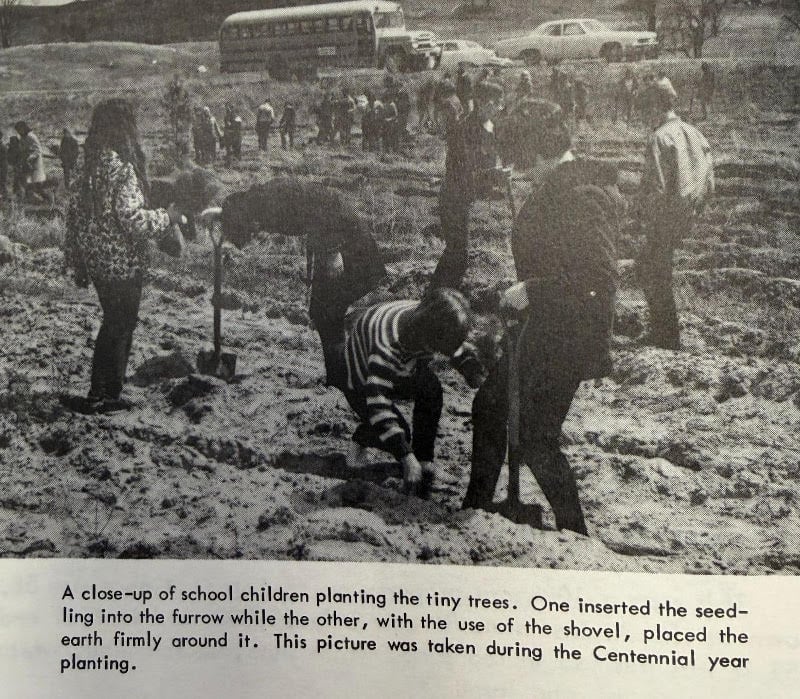
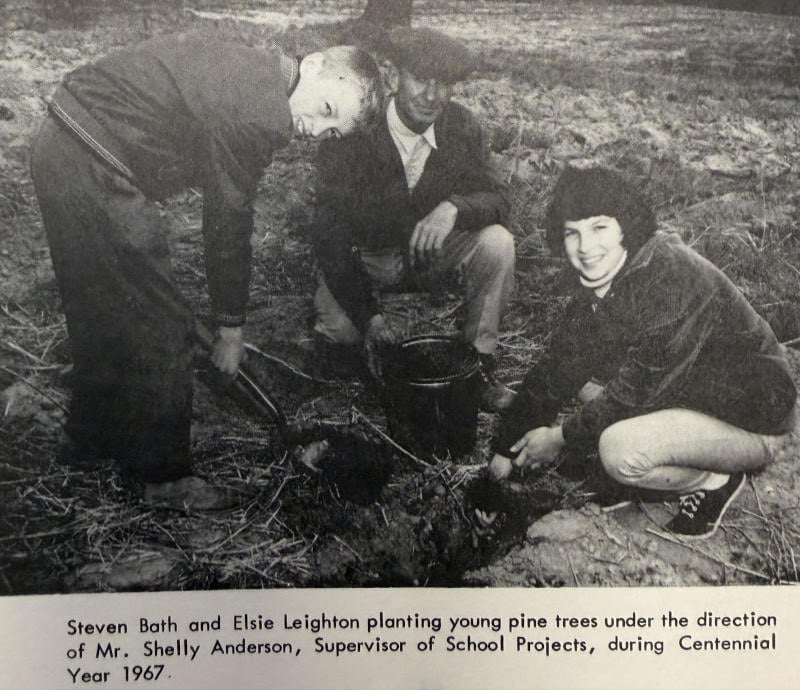
In 1949 Shelly Anderson entered the story. He had attended a Committee on Soil Depletion and was moved by a recommendation that “..support be given to Boys and Girls Forestry Clubs designed to promote reforestation..”. Mr. Anderson saw an opportunity to get trees planted in large numbers by students of the area while at the same time instilling in the children an understanding and it was hoped a love of trees. After persuading the Mono Township Area School Board and Mono Township council of the merits of the idea, a program was born which lasted from 1949 to 1968 during which upwards of 85,000 trees were planted by school children. From the purchase of the first tract of land in 1926 to 1968 over 360,000 trees were planted on the acquired lands which now comprise 460 acres of Mono Forest Tracts.
These early reforestation efforts used conifers. Conifers tolerate poor soils well, establish quickly and have high survival rates compared to hardwoods. Conifer seedlings were easy to grow in nurseries and could be planted in rows with simple methods. The trees grew fast and the uniform plantations could be harvested efficiently. The goal now is to establish a naturally occurring forest. Regular thinning creates gaps that allow natural light to reach the forest floor encouraging regeneration of hardwood species. Tree seeds are deposited by wind, mammals and birds.
We have dramatically changed the forest on the Side Trail in the last 150 years. We have harvested the old growth trees. We have turned a dense forest into a stubbled field. We have seen the soil blow away. We have seen new trees planted. Maybe, if we keep at it, in 150 years a hiker will climb the hills of Hockley Heights Side Trail in a “green dark forest .. too silent to be real”*.
Hockley Heights Side Trail Story
footnotes:
The Green Hills of Mono: McKenzie, Anderson, Marshall
Town of Mono Forest Management Plan January 2022-December 2041
*Gordon Lightfoot