
Songbird! Is there a prettier name for a trail or one more evocative? The story goes that Brian Popelier, a Bruce Trail Conservancy ecologist, named the trail after it was initially flagged, rerouted a few times (including to accommodate butternut seedlings) and finally blazed by volunteers in 2012. Brian had noticed a variety of songbirds and the name followed.
He was right. Today Songbird Side Trail is an eBird Hotspot. eBird is a Cornell Lab of Ornithology initiative that gathers observations of birders worldwide and makes the data available to educators, scientists and other birders. It increases the understanding of the movements and needs of birds globally. And Songbird Side Trail is doing its small part in this global initiative. One recent observer who added to the eBird database counted 14 species in one day!
Three distinct vegetative communities can be found along this short 2.9 km looped trail. There is deciduous forest including a core of mature sugar maples. This mixed forest supports a wide range of woodland birds. There is also cultural woodland which can be defined as “a treed community that has been significantly influenced by past and ongoing human activity”*. On Songbird Side Trail this woodland feature manifests in hedgerow and thicket habitat which provides cover and habitat for bird species like Indigo Bunting and Brown Thrasher to name just a few. This habitat is sometimes referred to as “edge” habitat and on Songbird Side Trail can act as a protective edge for the more sensitive mature sugar maple forest located further in. Edge habitat is also known for its biodiversity which supports a higher concentration of songbirds. And there is cultural meadow which refers to the open areas seen on the trail that are usually former agricultural fields or meadows now dominated by native grasses and herbs.These areas can provide nesting habitat and food sources for grassland birds such as Bobolink and Eastern Meadowlark.
The fact there are three very different habitats found on a short 2.9 km loop explains in part why so many songbirds can be sighted (or heard) on Songbird Side Trail. Another reason is the trail is not well travelled. A quiet trail will see birds sing more to attract mates or defend territory and they will tend to forage more in the open. In 2025 the main Bruce Trail was moved off Airport Road in this area. Songbird Side Trail used to run right off the Bruce Trail but is now an orphan of sorts. A main Trail hiker has to commit to walking a stretch of Airport Road to get to Songbird Side Trail now. Those who do might just be rewarded with the varied birdsong the trail is known and named for.
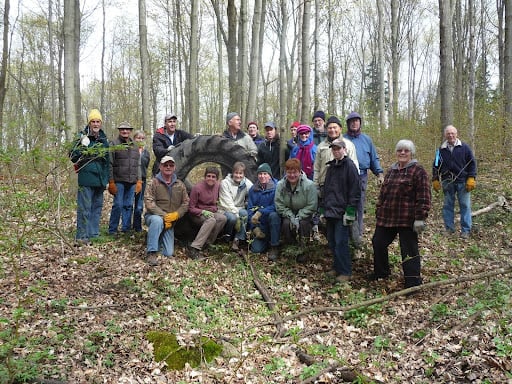 Earth Day, April 22, 2012 – More than 30 CHBTC volunteers cleaned up the Song Bird Nature Reserve, filling two disposal bins with scrap metal and other assorted trash. One of the most impressive feats of the day was the removal of a huge tractor tire that was found deep in the bush. A couple of energetic volunteers rolled the tire through dense underbrush, over hills, rocks and fallen trees to a point where others joined in to get it to the road for proper disposal.
*Ontario Ecological Land Classification System